logo-01.8315cd3f.png&w=256&q=75)
Kenya's animation industry is growing faster than it can find trained people. If you have been treating your love for drawing and visual storytelling as a hobby, this article is for you.
Picture this. You are in class, Form Three maybe, and instead of taking notes you are drawing characters in the margins of your exercise book. A teacher walks past, sees the drawings, and says something like "very nice, but focus on your studies." Nobody in that room connects what you are doing to a career. Nobody says "actually, that skill is worth money."
That is the story of almost every animator working in Kenya today. They were the kid with the sketchbook, the one who watched cartoons and wondered how they were made, the one who taught themselves Photoshop at a cyber cafe because nobody had told them there was a school for this. Most of them found their way into the industry the hard way. The ones who thrived were the ones who eventually got structured training, built a real portfolio, and found the studios that were looking for exactly what they had.
The industry they entered is not small. It is not a niche. And in 2026, it is actively looking for more people.
What is happening in animation right now
Netflix, Showmax, and YouTube are competing for African animated content. Brands in Nairobi, Mombasa, and Kisumu are paying for motion graphics in every campaign, every product launch, every social media reel. The gaming industry is one of the fastest growing tech sectors on the continent, and games do not exist without animators. Advertising agencies need people who can make things move.
The global animation industry is valued at over 400 billion dollars. Africa is a small percentage of that right now. But that percentage is growing, and the gap between the stories this continent wants to tell and the trained people available to animate them is real.
Studios are not struggling to find work. They are struggling to find trained people to do the work. That is an unusual problem. And for anyone willing to take the training seriously, it is a genuine opening.
Animation is not just cartoons
When most people hear "animation career" they picture someone making children's cartoons. That is one part of the industry. Here is what the rest of it looks like in practice.
Motion graphics is animation applied to communication. Every time a brand logo animates on screen, every time statistics move across a news broadcast, every time a social media video uses animated text to drive a point home, that is a motion graphics artist's work. It is one of the most commercially active disciplines in Kenya's digital economy right now, and the demand is only going up as video content continues to dominate every platform.
3D modelling and animation is the backbone of modern film and game production. Product visualisation, architectural walkthroughs, character animation for games, visual effects for local film and TV productions. A company in Westlands launching a new product and a gaming studio in Lagos need the same core skills.
Character design is its own discipline. Creating a character that works, that reads correctly at different sizes, and that communicates personality through shape, proportion, and colour before they say a single word is something that takes real training to learn well. A well-designed character can anchor a franchise. This work receives licensing, sales, and years of development.
And then there is the work that most people do not see: post-production visual effects, compositing, the digital artists who take raw footage and turn it into what audiences eventually watch. As Kenya's film and TV sector grows and more local content gets licensed by streaming platforms, this work is becoming more available locally than it has ever been.
What the salaries actually look like
These are realistic figures for Kenya's market at different career stages. Not inflated. Not promises. What trained animators with professional portfolios are actually earning.
Entry level: KES 40K–80K per month
Mid career:KES 100K – 200K per month
Senior / Freelance: KES 200K+ per month
Freelancers working with international clients can go well beyond those figures. A Nairobi-based animator with a strong showreel working remotely for a London studio or a Dubai advertising agency is billing in pounds and dirhams. The work follows the portfolio, not the passport.
Why self-learning stalls out
YouTube has made a generation of people who know what animation looks like. It has not created a generation of people who are hired to do it.
The broken feedback loop poses a significant challenge to self-teaching animation. You make something, you watch it back, you think it looks okay, and you move on. You don't know what a director or studio would say about it because no one with experience has looked at it and told you what's working and what's not. You are calibrating your standards against your own previous work, which means your ceiling is wherever your instincts currently are.
There is also the portfolio problem. Employers and clients do not care how many tutorials you have watched. They care what you can produce. Building a portfolio that reflects professional-level work requires real projects, real briefs, and the kind of iterative critique that you simply cannot give yourself. Most self-taught animators who apply for studio roles are rejected not because they lack passion or potential but because their portfolio does not yet show they can work to a professional standard.
Structured training closes both of those gaps. You work on real projects. People who are professionals in this field review your work. You build a showreel that represents you accurately to the industry. You graduate knowing the tools, the standards, and the people.
What ADMI's animation training covers
ADMI's Animation and Motion Graphics Diploma is a two-year programme. It starts where most people actually are, drawing fundamentals, animation principles, character design, and it builds systematically toward the kind of technical and creative depth that studios are hiring for.
The twelve principles of animation are the grammar of the discipline. Squash and stretch, anticipation, staging, follow-through. These are not historical trivia. They are what separates movement that feels alive from movement that feels like a PowerPoint slide. They are taught here not as theory but through production, through actually making things and having working professionals tell you why a scene lands or why it does not.
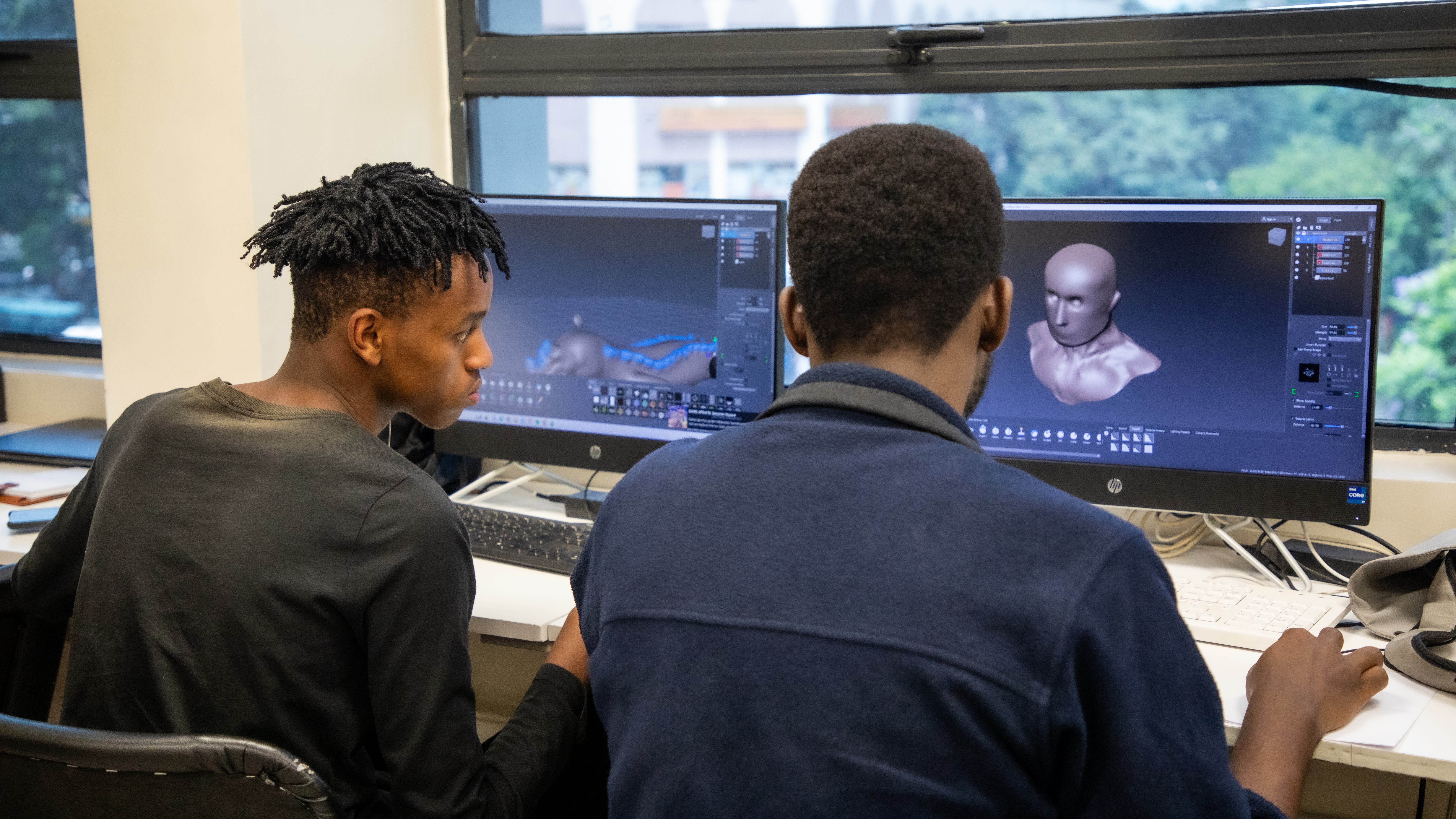
The tools you graduate proficient in are the ones the industry uses. ToonBoom for 2D animation. Adobe After Effects for motion graphics. Blender and Autodesk Maya for 3D. Unity for game-adjacent work. By the time you leave, these are not software you have heard of. They are environments you have spent two years working in.
The final semester is a mandatory paid placement in the industry. Not an observation. Not a shadow programme. Actual work, at an actual company, applying what you have learned in a real production environment. For many ADMI animation graduates, this is also where they receive their first job offer. Eighty-eight percent of diploma graduates are employed within six months of completing the programme.
The diploma is ECTS-accredited through Woolf and registered with TVETA Kenya. Your qualification is recognised by employers locally and internationally.
The sketchbook kids are the ones who make it
Here is something the animation industry consistently finds true. The students who become the strongest animators are not always the ones with the most technical background on day one. They are the ones who have been drawing their whole lives, the ones who have been telling visual stories since before they knew there was a name for it, the ones who fill notebooks and margins and corners of receipts with characters and scenes and worlds that exist nowhere but in their head.
What formal training does for those people is give language and structure and technique to something they were already doing instinctively. It takes the person who was always going to end up in this industry and gives them the fastest and most direct route to being genuinely good at it professionally.
Africa's next great animated stories are already living in someone's sketchbook. The only question is whether the person holding the pen decides to take the training seriously enough to bring them to a screen.
Two years. A showreel. A career that was always yours. ADMI's May and September 2026 intakes are open. No portfolio required to apply.Animation & Motion Graphics Diploma 2D Animation Certificate Apply now Questions? WhatsApp ADMI Admissions: (+254) 741 132 751